If you’re in mining, construction, or water well drilling, you know DTH hammers are workhorses—they can make or break your project timelines and operating costs. But let’s be real: even the top-tier DTH hammer you bought a year ago might not be hitting the efficiency mark it should. As someone who’s spent years selling and troubleshooting these tools (I run a DTH hammer supply outfit, so I see every messy, problem-filled job), I’m here to cut through the jargon and give you actionable, science-backed ways to crank up your hammer’s efficiency without blowing your budget or risking downtime. DTH Hammer
First: Stop Wasting Air Pressure—That’s the #1 Efficiency Killer
Let’s start with the biggest mistake I see drillers making: cranking the air compressor higher than your hammer needs. A DTH hammer’s sweet spot is usually 90-150 PSI, depending on the model and rock hardness. More pressure doesn’t mean faster drilling—it just makes the hammer waste air, wear out parts faster, and overwork your compressor. I’ve had guys come to me with hammers that were running on 180 PSI because “they thought more = better” and their tool was barely drilling 20 feet an hour. We swapped in a pressure regulator calibrated to their rock type, and boom—they jumped to 32 feet an hour, no new hammer needed.
Here’s the science bit: DTH hammers work because air drives the piston that strikes the bit. Too much air pressure creates extra backpressure in the hammer’s cylinder, which robs energy from the piston’s forward strike. The ideal pressure matches the hammer’s air consumption rate (check your manual—don’t guess). For soft rock (like limestone or sandstone), stick to 90-110 PSI; for hard rock (granite, basalt), push to 130-150 PSI max. Also, make sure your compressor is sized right for your hammer. A 5-inch DTH hammer, for example, needs at least 300 CFM of free air delivery (FAD). If your compressor is only 250 CFM, you’re starved for air, so the hammer can’t strike as hard. That’s a easy fix—upgrade your compressor if it’s undersized, or downsize your hammer if it’s too big for your compressor.
Bit Choice: It’s Not a “One-Size-Fits-All” Game
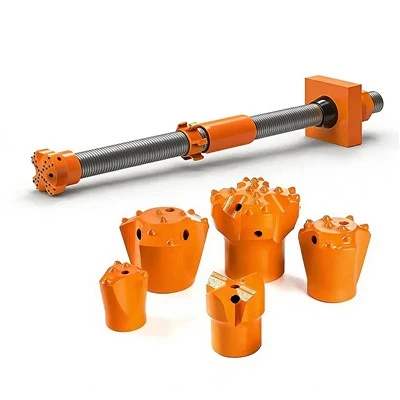
I can’t tell you how many times a driller shows up with a standard all-purpose bit and wonders why it’s chewing through bits in hard rock. Bits are the hammer’s contact point with the rock, so picking the wrong one kills efficiency fast. Let’s break it down: carbide bit buttons are your main weapon here. For soft rock, you want larger buttons (13-15 mm diameter) because they spread the force over more area, so they don’t sink too deep and stall. For hard rock, smaller, harder buttons (10-12 mm) are better—they’re denser, so they can take repeated strikes without chipping, and they focus force on a smaller area to break up dense rock.
Another thing: bit face design. Flat face bits work for medium rock, while concave face bits give better center strike for hard rock (so the bit doesn’t wander) and convex face bits are for soft, friable rock that crumbles easily. Also, check your bit shank thread—make sure it’s compatible with your hammer. A mismatched shank causes air leaks, which saps power, and can even damage the hammer’s internal splines. Last month, a driller used an old shank on a new hammer, and the leak cost him an extra 2 hours of downtime to repair. It’s a $15 part—don’t skip it.
Keep It Clean: Air Filtration Is Non-Negotiable
Dirty air is the silent killer of DTH hammers. Dust, oil, and moisture in the air line get into the hammer’s internal parts, causing friction, rust, and clogs in the air passages. I’ve seen hammers that lasted 200 hours instead of the 800+ they should because the driller skipped regular filter changes. Here’s the routine: first, install a primary air filter close to the compressor to catch large particles, and a secondary inline filter right before the hammer to trap moisture and tiny dust particles. Change the primary filter every 50 hours of operation, and the inline filter every 100 hours. Also, drain the air tank daily—moisture buildup is a huge issue, especially in humid climates. When moisture mixes with dust, it forms a paste that gums up the piston, so the hammer can’t move fast. That slows drilling way down, and it’s totally preventable.
Pro tip: If you’re drilling in super dusty environments (like open-pit mines), add a third filter—this one with a water separator. I keep a stock of these for my clients in Arizona, and they cut hammer repairs by 40%. Don’t cut corners on filters—your hammer’s internals are precision-machined, and a tiny speck of sand can scratch the piston wall, leading to leaks and lost power.
Alignment Is Everything: Don’t Let Off-Center Strikes Waste Energy
If your hammer isn’t aligned straight with the drill string, every strike is going sideways instead of straight into the rock. That’s a massive waste of energy, and it also wears out bits and hammer parts way faster. I see this all the time on job sites where drillers rush to set up, so they don’t level the rig or check the string alignment. A misaligned drill string can reduce drilling efficiency by 25%—no joke. Here’s how to fix it: first, use a dial indicator to check the alignment between the hammer, drill pipe, and bit before you start drilling. If you’re using a rotary table, make sure the bit is centered in the hole as you go. Also, check for bent drill pipes—even a slight bend (less than 1 degree) can throw off alignment over time. Replace any bent pipes immediately, even if they look fine on the outside. Last year, a driller with a bent pipe was drilling a well and was only going 15 feet an hour. We replaced the pipe, and he jumped to 28 feet an hour. He still texted me a month later saying that pipe was the “best $500 he ever spent.”
Another alignment thing: keep the drill string under tension, not compression, when drilling. Compression makes the string bend, while tension keeps it straight. For deep holes (over 100 feet), add a centralizer every 50 feet to keep the pipe aligned. That’s a cheap add-on, but it makes a huge difference in how hard the hammer strikes.
Lubrication: Too Much or Too Little Is Bad
Lubrication is a balancing act. Too little, and the piston and cylinder wall rub together, causing friction and overheating. Too much, and the oil coats the bit buttons, making them slip instead of bite into the rock, and it can clog air passages. Most DTH hammers use a mist lubricator, which mixes oil with the compressed air to lubricate internal parts. The rule of thumb is 1-2 drops of oil per 10 CFM of air flow. For a 5-inch hammer, that’s 30-60 drops a minute. Don’t just eyeball it—use a flow meter to set it right. If your hammer is making a high-pitched squeal, that’s not good—it’s metal on metal, so you’re running too low on oil. If you see oil coming out of the drill bit, you’re using too much.
Also, use the right oil. Hydraulic oil is not the same as DTH hammer oil. DTH hammer oil is designed to mix with air, withstand high temperatures, and not leave residue. Using the wrong oil can leave gunk in the hammer, leading to clogs and reduced efficiency. I always tell my clients to use the manufacturer-recommended oil—it’s a small cost that saves you big on repairs.
Regular Maintenance: Don’t Wait for a Breakdown
Efficiency isn’t just about on-the-fly fixes—it’s about consistent maintenance. I see drillers who only service their hammer when it breaks down, and that’s a mistake. A hammer that’s 80% efficient costs you 20% more per foot drilled, which adds up fast over a job. Here’s a simple maintenance schedule: every 100 hours, do a full inspection. Check the piston for wear, the O-rings for cracks, and the air passages for clogs. Every 500 hours, replace the piston and O-rings—even if they look fine. Those parts are cheap, and they’re the ones that wear out the fastest. Last year, a gold mining client of mine skipped a 500-hour service, and his hammer blew a piston mid-drill, costing him 3 days of downtime and $12,000 in lost production. If he’d just done the service, it would’ve cost him $800. That’s a no-brainer.
Also, keep spare parts on hand. Don’t wait for a part to break to order it. I stock common parts (O-rings, pistons, bits) for my clients, so they can swap them out in 10 minutes instead of waiting 2 days for delivery. Down time is the biggest efficiency killer—if your hammer is down, you’re not making money.
Final Thought: It’s All About Matching Your Setup to Your Job
At the end of the day, DTH hammer efficiency isn’t about buying the biggest, most expensive hammer. It’s about making sure every part of your setup—compressor, hammer, bit, drill string, maintenance routine—works together for the specific job you’re doing. Too many people treat DTH hammers like a set-it-and-forget-it tool, but they’re precision machines that need small tweaks to hit their full potential.

If you’re not seeing the efficiency you should, or you need help sizing a compressor, picking the right bit, or setting up a maintenance schedule, hit me up. I’m here to help you get more out of your hammer, less downtime, and lower operating costs. Let’s chat through your project, and I can hook you up with the right solutions for your needs.
Button Bit References
- Atlas Copco. (2021). DTH Hammer Efficiency Guide for Construction and Mining.
- Society of Petroleum Engineers. (2019). Drilling Efficiency Optimization for Down-The-Hole Hammer Applications.
- International Society of Explosives Engineers. (2020). Rock Bit Selection and Performance for DTH Drilling Operations.
- Compressed Air and Gas Institute. (2018). Air System Design for Industrial Drilling Equipment.
Super Rock Machinery Equipment (Qingdao) Co., Ltd.
We are one of the most professional DTH hammer manufacturers and suppliers in China, featured by quality products and good price. Please feel free to buy advanced DTH hammer for sale here from our factory. Welcome to view our website for more information.
Address: No.45, Pengwan Road, Qianwan Bonded Port Area, Qingdao Sub-district, Free Trade Pilot Zone, Shandong China
E-mail: sales@superrocktools.com
WebSite: https://www.superrocktools.com/
